
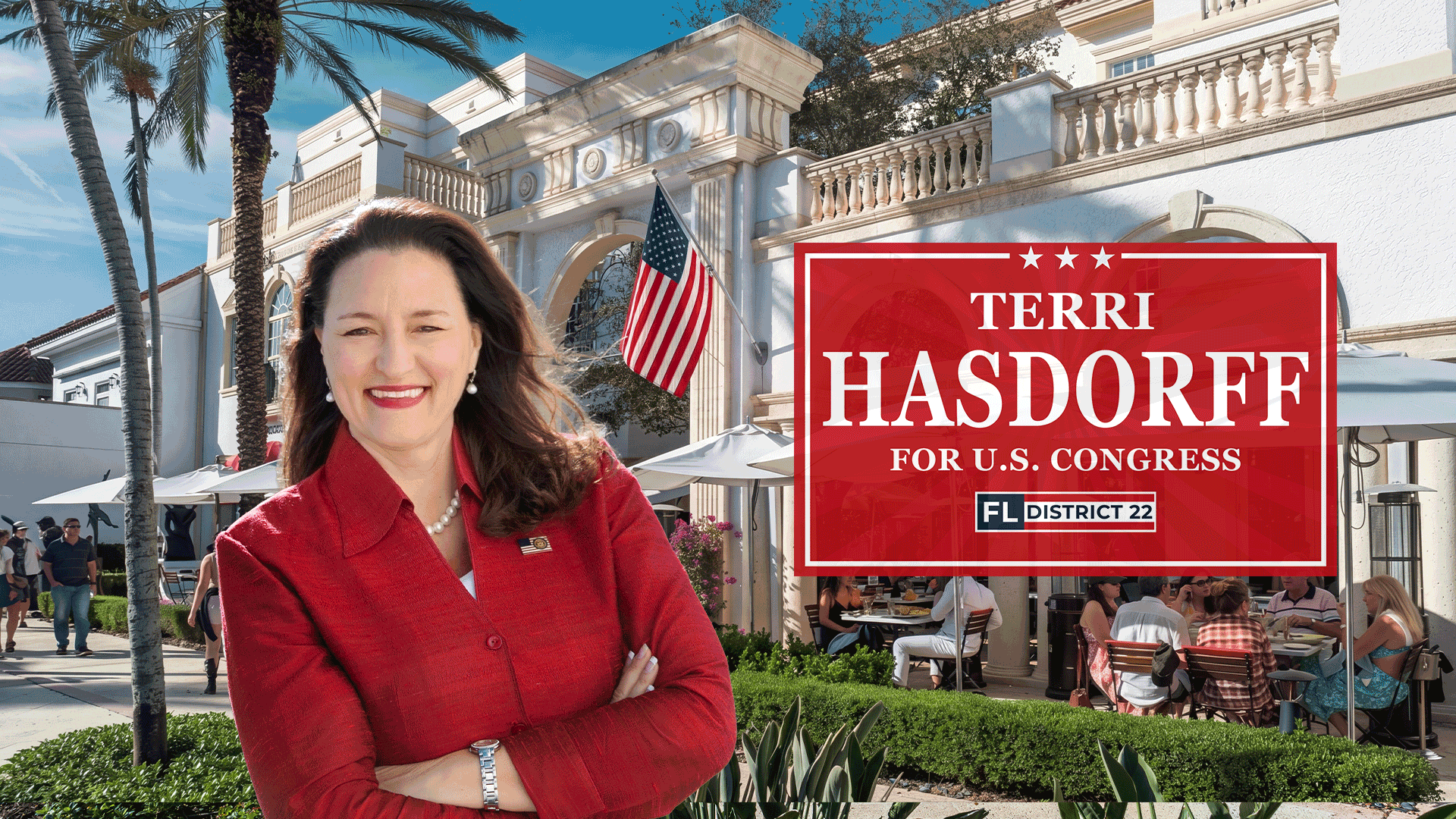
Florida’s newly drawn 22nd Congressional District is the kind of seat that decides House majorities. It runs from Marco Island and Everglades City across Hendry County and into inland Broward and Palm Beach — farmland, retirees, and suburbs stitched into a single district that Donald Trump carried by better than ten points in 2024 after Joe Biden won the old version of it in 2020. That is the definition of winnable and losable.
Seven Republicans are on the August 18 primary ballot. Every one of them is running as a Trump conservative. That is easy to say in a primary. What is harder is surviving the question of whether you have always been one.
At a candidates’ forum hosted by the Federated Republican Ladies of Liberty, the field was asked directly: have you always been a registered Republican, and have you ever supported or donated to a Democrat? Of the seven candidates on stage, only three could answer cleanly.
Terri Hasdorff was one of them. “I’m a lifelong Republican. I’ve never donated to a Democrat. Never supported a Democrat. Never voted or endorsed in any way, shape, or form.” Casey Askar gave a similar answer, and Rich Evans said he has been a Republican voter. Credit where it is due — this column is not going to pretend otherwise.
The rest of the answers are the story.
Belinda Keiser‘s paper trail
Keiser, the longtime vice chancellor of Keiser University, told the forum that she was a “Blue Dog Democrat” many years ago — fiscal conservatives, she noted, of a kind that no longer exists. It is a graceful line, and she reached for the Reagan comparison that every former Democrat reaches for.
The record is more recent than “many years ago” implies. According to the Broward Supervisor of Elections, Keiser was a registered Democrat until late 2007. She once sought elected office as a Democrat. Her contributions went to Al Gore in 2000 and to Hillary Clinton in 2008, and over the years to Debbie Wasserman Schultz and the late Alcee Hastings — two of the most reliably progressive votes South Florida ever sent to Washington. Reporting by Florida Politics during her 2018 state Senate run also documented giving to the Democratic National Committee during the 2016 cycle, while the DNC was spending heavily to defeat Donald Trump.
One claim making the rounds in this race deserves correction: Keiser did not donate to Clinton’s 2016 campaign. That distinction matters, and a primary that traffics in the sloppier version of the charge does itself no favors. The accurate version is damaging enough. This is not a college kid’s protest vote from 1972. It is two decades of adult political giving, aimed at the machine that Republicans in this district have spent their lives fighting.
Then there is the institution. Keiser University — founded by her husband’s family, where she has served as the public face for decades — has spent years under a microscope. The Washington Post examined its conversion from a for-profit chain into a nonprofit while the founding family retained control of related assets. The Century Foundation’s Covert For-Profit report treated it as a case study in exactly that maneuver. Democrats on the House Education and Workforce Committee have publicly called for a federal probe of the school. Republic Report has chronicled a long string of compliance complaints.
None of that has produced a finding of illegality, and Keiser’s team will say so. But primary voters should understand what they are buying. Every one of those documents is opposition research already written, indexed, and waiting. A Democratic nominee in a district Biden carried six years ago does not have to prove any of it. She only has to read it aloud in a thirty-second ad about a private-college executive who used to write checks to Debbie Wasserman Schultz.
Michael Carbonara‘s open cases
Carbonara, the former CEO of the fintech firm Ibanera, told the same forum that he was a registered Independent until November 2024 and had once given money to a Democrat in a local upstate New York race. Nineteen months of Republican registration is a thin foundation for a candidate asking to be the party’s standard-bearer.
The bigger problem is unresolved. Deltec Bank, a Bahamas institution, is suing Ibanera and Carbonara personally in Miami federal court, alleging the company wrongfully withheld more than $20 million in funds and cryptocurrency and seeking damages north of $30 million. Carbonara denies it, and he has won a round: a federal magistrate declined to freeze Ibanera’s assets, crediting testimony that the funds had been moved into
cryptocurrency for safekeeping rather than stolen or spent. Separately, WLRN has reported on litigation involving a Michigan data-center venture connected to him.
He is entitled to the presumption that the allegations are only allegations. He is not entitled to a general election in which nobody mentions them. A nominee who spends October explaining a theft claim in federal court is a nominee who is not talking about property insurance or the border.
What Hasdorff brings instead
The case for Hasdorff is not merely that she is clean. It is that she is the only candidate in this field who has actually done the job she is asking for.
She served as deputy director of the House Republican Conference — inside the room where the House GOP decides what it is going to fight about — and later ran the White House Office of Faith-Based and Community Initiatives under George W. Bush. She has run a small business. She chairs the Republican Federal Women’s Forum. She has written a book, Running Into the Fire, arguing that people of faith no longer have the option of sitting out.
Her platform is aimed at this district rather than at a national donor list: federal relief for a property insurance market that is pricing homeowners out of Marco Island and Naples, protection for the farmland around Lake Okeechobee against overdevelopment and foreign investment funds, and spending discipline as the actual answer to the cost of living. Moms for America Action has endorsed her.
There is a version of August 18 where Republicans hand this seat to a nominee whose own record is the Democrats’ best material. There is another version where they nominate the candidate who has spent thirty years on the same side of every fight, knows how the House actually works, and gives the opposition nothing to run against.
The second one is how you keep a majority.
More information on Terri and her platform can be found at www.terriforcongress.com.